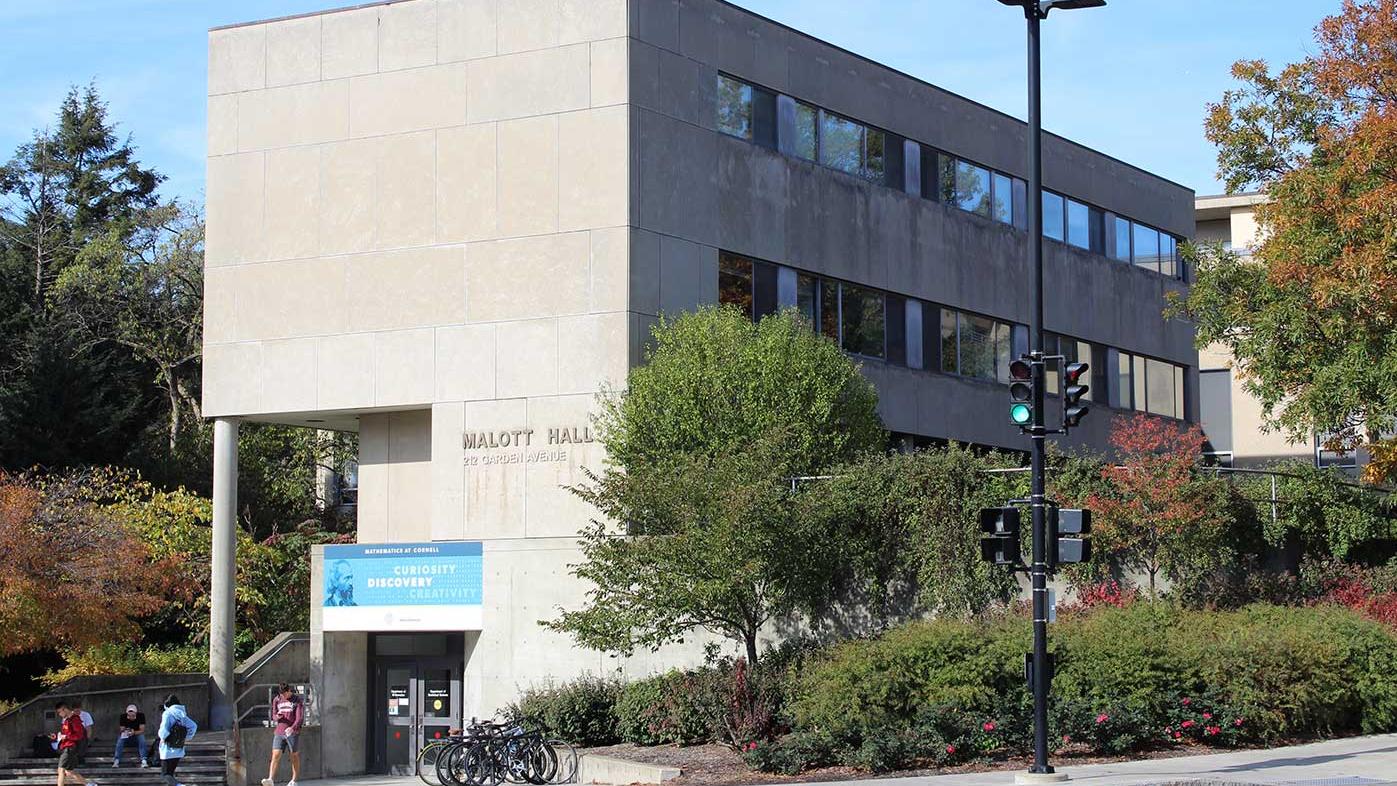
The Department of Mathematics at Cornell University is a world leader in graduate and undergraduate mathematics education, and mathematical research. The 43 tenured and tenure-track faculty represent a broad spectrum of current mathematical research, while a lively graduate student population represents the global reach of department.
Stretching shapes and building tools: topology at Cornell
Topologists study geometric objects and how they hold up when deformed by stretching, twisting or bending. They explore how these objects fit together, how you can reshape them and what you can do with them in any number of dimensions.
Cornell mathematician Steven Strogatz discusses AI’s growing impact on mathematics in The Daily podcast. The Cornell University professor examines AI’s breakthrough solution to the Navier-Stokes equation and its implications for mathematical research and discovery.
Cornell University mathematicians received major grants to advance AI safety and AI-powered mathematics research. College of Arts & Sciences faculty Lionel Levine and Daniel Halpern-Leistner are developing tools for safer AI systems and computer-verified mathematical reasoning.
AI is rapidly solving longstanding math problems, prompting debate about the future of mathematical discovery. In the New York Times, mathematicians from Cornell's College of Arts and Sciences argue that human experimentation and problem-solving remain essential to understanding and advancing the field.
Twenty new faculty have joined the College of Arts & Sciences this year, strengthening departments and programs with their wide-ranging expertise and filling numerous leadership roles for the College and university.
More than 100 researchers gathered at Cornell University in June for SPA 2026 probability conference co-organized by College of Arts and Sciences mathematics professor Laurent Saloff-Coste and Cornell Duffield Engineering professor Gennady Samorodnitsky.
Mathematics is the language of modern science; basic training in the discipline is essential for those who want to understand, as well as for those who want to take part in, the important scientific developments of our time.
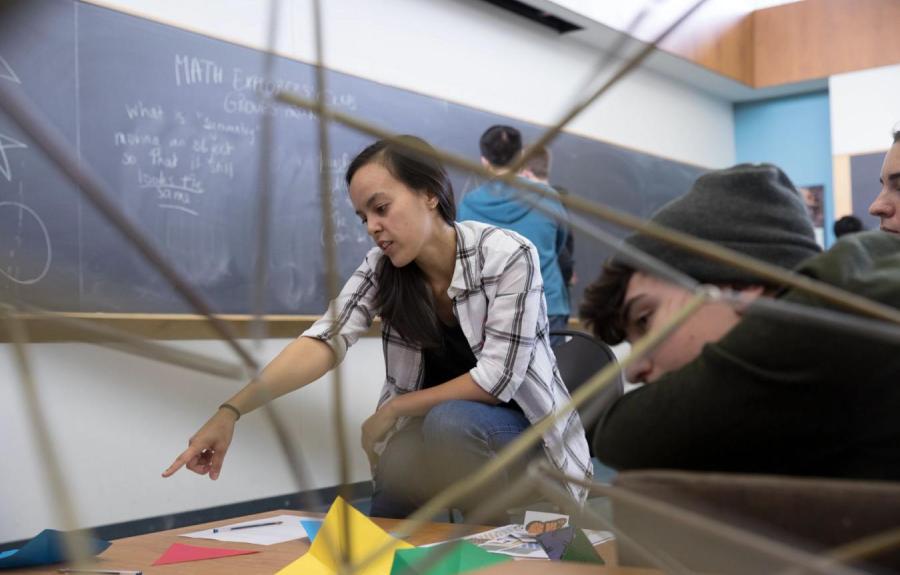
Graduate student Hannah Keese leads a meeting of the Math Explorers Club, where graduate students teach math to interested local high school students.
Lindsay France
Graduate Program
The Department of Mathematics at Cornell University offers a rigorous graduate program, leading to the Ph.D. degree, that combines study and research opportunities under the direction of an internationally known faculty.